
Discovery of the Titanic Wreck
Background
Discovery of the Titanic Wreck was a remarkable feat of marine exploration. The long-lost wreckage of the RMS Titanic was discovered on the ocean floor, 73 years after the fateful night it sank. A joint American-French expedition, led by Dr. Robert Ballard of the Woods Hole Oceanographic Institution and Jean-Louis Michel of the French Research Institute for Exploration of the Sea, successfully located the renowned shipwreck on September 1, 1985.
For over seven decades, the location of the Titanic’s resting place remained an enigma, shrouded in mystery and speculation. But armed with cutting-edge technology and a determined spirit, the team aboard the research vessel Knorr embarked on a groundbreaking mission to uncover the truth hidden beneath the icy depths of the North Atlantic.
Argo
Using a combination of remote-operated vehicles (ROVs) and sonar equipment, the team meticulously surveyed the ocean floor, meticulously scanning the vast area where the Titanic was believed to have sunk. After weeks of painstaking search, on the morning of September 1, 1985, the efforts of the expedition bore fruit. A remotely operated vehicle named Argo, equipped with high-definition cameras, captured the first glimpse of the Titanic since its tragic demise.
Argo was specifically designed to operate in challenging environments such as underwater mountain ranges. Its towed sled had the capability to function at depths of 6,000 meters (20,000 feet), providing access to approximately 98% of the ocean floor. The initial version of Argo, which was instrumental in the discovery of the Titanic, had dimensions of 15 feet in length, 3.5 feet in height, and 3.5 feet in width. It weighed approximately 4,000 pounds in air. Equipped with a range of forward-facing and downward-facing cameras, as well as strobes and incandescent lighting, Argo effectively illuminated the ocean floor.
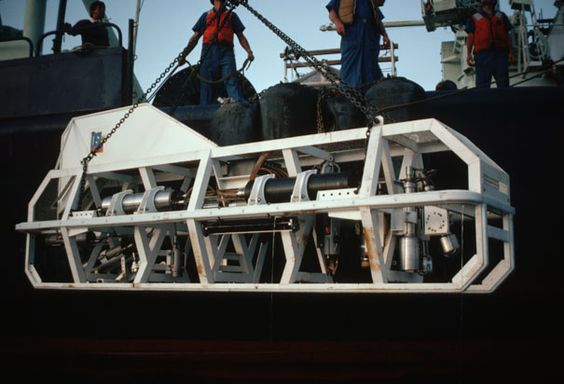
This innovative tool, incorporating readily available components along with specially developed software and cable systems, aimed to enhance our capacity for deep-sea exploration. Dr. Robert Ballard, the leader of the Deep Submergence Laboratory responsible for Argo’s development, is a geologist who has dedicated the majority of his 30-year research career at WHOI to investigating the Mid-Ocean Ridge. Stretching over 45,000 miles, the Mid-Ocean Ridge constitutes the largest single feature on Earth’s surface, covering more than 20% of the planet. The initial exploration of the Mid-Atlantic Ridge, a segment of the overall Mid-Ocean Ridge system, began in 1973, with Dr. Ballard among the participating scientists. By 1985, only 120 miles of data had been collected over a span of 12 years. However, the first scientific deployment of Argo in December 1985 enabled Ballard and his colleagues to cover nearly 120 miles of the East Pacific Rise in just 20 days.
Due to its ability to capture enhanced images and navigate treacherous underwater mountain ranges, Argo found numerous applications. Geologists and geophysicists were able to survey large areas and examine smaller features up close. Biologists conducted population surveys of seafloor organisms, while geochemists utilized Argo to study hydrothermal vents, where deep-sea chemicals sustain unique forms of marine life.
In another groundbreaking achievement, Argo located the sunken German battleship Bismarck, which had been submerged in water nearly 15,000 feet deep off the coast of France, in June 1989. Initially, the plan in 1985 was for Argo to transport Jason, a robotic vehicle under development by the Institution’s Deep Submergence Laboratory, for close-up inspections of seafloor features and sample collection using a manipulator. However, subsequent at-sea tests with Jason in 1989 led to a change in plans, resulting in the separate usage of the two vehicles. The original Argo was retired in the 1990s. Presently, the Institution has made advancements in this technology and employs several uniquely designed towed vehicles for oceanographic missions worldwide.
Discovery
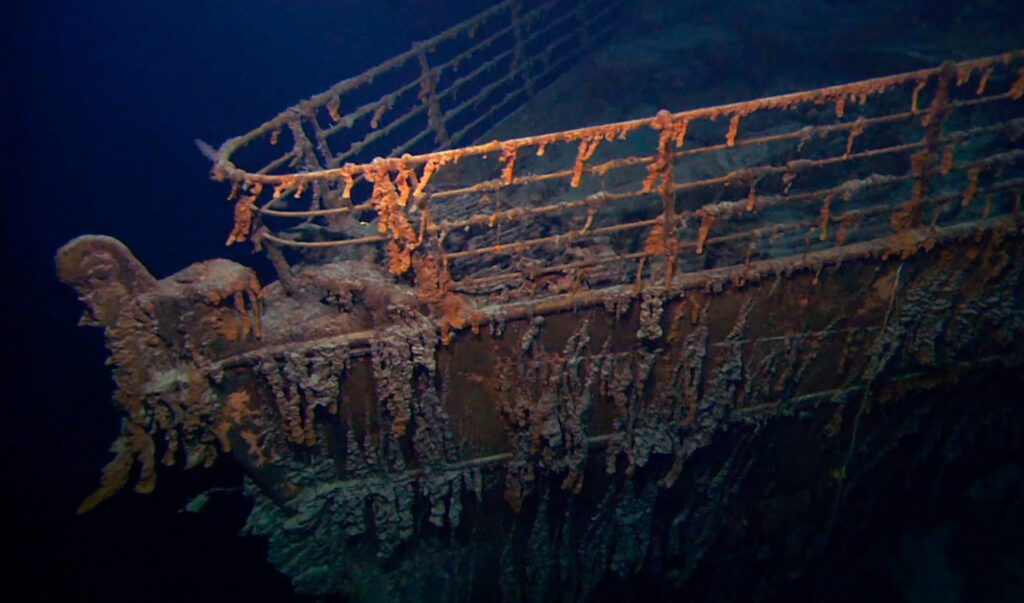
The image that appeared on the ship’s monitors revealed the haunting silhouette of the ship’s bow, lying in a fractured state but remarkably well-preserved. The sight of the iconic vessel, covered in marine growth and surrounded by scattered debris, sent shockwaves of excitement throughout the team. For the first time in over seven decades, the world could once again bear witness to the remains of the “unsinkable” Titanic.
Dr. Robert Ballard, overwhelmed with emotion, shared his thoughts, saying, “It’s a sight that both breaks my heart and fills it with awe. The Titanic’s discovery marks a poignant moment in history, offering us an opportunity to honor the memory of those who perished and gain further insight into one of the greatest maritime tragedies.”
News of the discovery spread like wildfire, capturing the attention of people worldwide. The Titanic’s ill-fated voyage in 1912, which claimed the lives of over 1,500 passengers and crew members, left an indelible mark on the collective human consciousness. The ship’s luxurious reputation and the stories of heroism and tragedy that emerged from the disaster have captivated generations, making the discovery of its wreckage a monumental event.
The News
While the exploration of the Titanic’s wreck is far from over, this initial revelation opens the door to a new era of exploration and understanding. The information gathered from the site will provide invaluable insights into the ship’s final moments, the condition of its structure, and the environment in which it now resides. It also serves as a reminder of the fragility of human achievement and the enduring power of historical preservation.
As the world reflects on the discovery of the Titanic’s wreck, one thing is certain: the story of this legendary vessel and the lives it touched will continue to captivate and inspire for generations to come.